
Tesla’s Full Self-Driving system has undergone a massive transformation. The latest update increases neural network parameters by ten times. This change fundamentally alters how Tesla vehicles perceive their surroundings. Understanding these improvements helps drivers appreciate the technology powering their cars.
Understanding Tesla’s Vision-Only Approach
Tesla made a bold decision in 2021. The company removed radar sensors from its vehicles. Instead, Tesla chose to rely entirely on cameras. This approach mirrors how humans drive using only their eyes.
The vision-only system uses eight cameras positioned around the vehicle. These cameras capture everything happening in all directions. However, the real magic happens in the processing. Tesla’s neural networks interpret these camera feeds to understand the environment.
What the 10x Parameter Increase Means
Parameters are the building blocks of neural networks. Think of them as the brain cells that help the system learn and make decisions. More parameters generally mean better pattern recognition and more nuanced understanding.
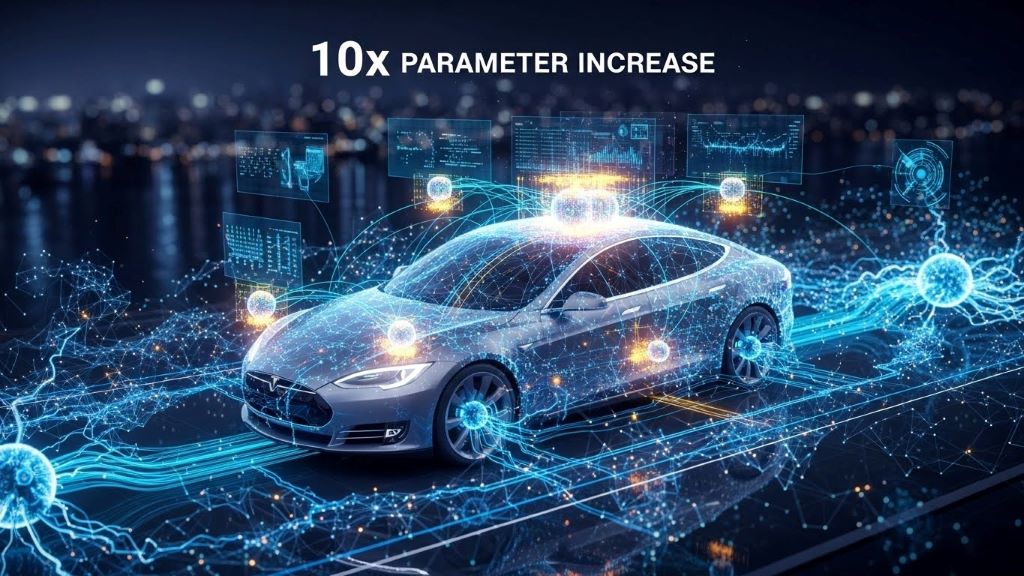
The previous FSD system used approximately 10 million parameters. The new update pushes this number to around 100 million parameters. This tenfold increase represents a quantum leap in processing capability.
Additionally, more parameters allow the system to recognize subtle details. The network can now distinguish between a plastic bag blowing across the road and an actual obstacle. This distinction was previously challenging for the system.
How Vision Perception Accuracy Improves
The expanded neural network processes visual information differently now. Previously, the system might struggle with edge cases or unusual scenarios. The new architecture handles these situations with greater confidence.
Depth perception has seen remarkable improvements. Without radar, cameras must estimate distances using visual cues alone. The 10x parameter update enhances this capability significantly. The system now calculates distances more accurately, especially for objects at varying ranges.
Furthermore, object classification has become more precise. The network can distinguish between different vehicle types, pedestrians, cyclists, and stationary objects with higher accuracy. This matters when the car needs to predict how different road users might behave.
Real-World Performance Changes
Drivers have noticed tangible differences after the update. Highway driving shows smoother lane changes and better spacing from other vehicles. The system now anticipates traffic flow patterns more effectively.
Urban driving presents the biggest challenges for autonomous systems. However, the updated FSD handles complex intersections with improved confidence. The vehicle recognizes traffic lights, stop signs, and pedestrian crossings more reliably.
Therefore, the system makes fewer unnecessary interventions. Previous versions might brake unexpectedly for shadows or reflections. The enhanced perception reduces these false positives considerably.
Technical Architecture Behind the Update
Tesla’s approach uses something called occupancy networks. These networks create a 3D understanding of the space around the vehicle. The 10x parameter increase allows for higher resolution occupancy mapping.
The system processes information at multiple scales simultaneously. It considers both immediate surroundings and distant objects. This multi-scale approach helps with planning smoother trajectories.
Moreover, the update includes improvements to temporal processing. The network now considers how scenes change over time. This helps predict where other vehicles or pedestrians will move next.
According to Electrek’s coverage of Tesla’s FSD updates, the company continues refining its vision-based system with each iteration. These incremental improvements build upon the foundation created by the massive parameter expansion.
Challenges That Remain
Despite impressive improvements, vision-only systems face inherent limitations. Cameras struggle in certain conditions where radar might excel. Heavy rain, fog, or direct sunlight can temporarily reduce perception accuracy.
The system still requires driver supervision at all times. Tesla emphasizes that FSD remains a driver assistance feature, not fully autonomous driving. Drivers must stay alert and ready to intervene.
Additionally, the increased parameters demand more computational power. Tesla had to upgrade the hardware in newer vehicles to handle the processing load. Older vehicles may not receive the full benefits of this update.
Training Data and Continuous Improvement
Tesla’s fleet provides an enormous advantage. Millions of vehicles collect real-world driving data constantly. This data helps train and refine the neural networks.
The 10x parameter model can learn from more diverse scenarios. It processes data from various weather conditions, lighting situations, and geographic locations. This comprehensive training improves generalization across different environments.
However, the training process never truly ends. Tesla continuously updates the system based on new data. Each software update brings incremental improvements to perception accuracy.
Comparing Vision-Only to Sensor Fusion
Many competitors use sensor fusion approaches. They combine cameras, radar, and lidar for redundancy. Each sensor type has strengths and weaknesses.
Tesla argues that vision-only systems can achieve superhuman performance. The company believes that with sufficient neural network capacity, cameras provide all necessary information. The 10x parameter update moves closer to proving this thesis.
Nevertheless, the debate continues in the autonomous driving industry. Some experts maintain that sensor redundancy provides essential safety margins. Others believe Tesla’s vision-first approach represents the future.
Impact on Safety Metrics
Safety remains the primary concern for any autonomous driving system. Tesla reports that vehicles using FSD have fewer accidents per mile than human drivers. However, independent verification of these claims remains limited.
The improved perception accuracy should theoretically enhance safety. Better object detection means earlier identification of potential hazards. More accurate depth perception enables smoother, safer maneuvering.
Therefore, drivers report feeling more confident with the updated system. The car’s decisions seem more predictable and human-like. This increased predictability can actually improve safety by making the vehicle’s behavior easier to anticipate.
Future Developments and Expectations
Tesla continues pushing the boundaries of vision-based perception. The company has hinted at further parameter increases in future updates. Each expansion brings diminishing returns, but improvements continue.
The ultimate goal remains full autonomy without driver supervision. The 10x parameter update represents a significant milestone toward this objective. However, achieving true autonomous driving requires more than just perception improvements.
Additionally, regulatory approval remains a major hurdle. Even with perfect perception, autonomous vehicles must meet strict safety standards. This process takes time regardless of technological readiness.
As reported by The Verge’s analysis of Tesla’s FSD progress, the company faces both technical and regulatory challenges on the path to full autonomy. The parameter expansion addresses technical limitations but cannot solve regulatory questions alone.
Conclusion
Tesla’s 10x parameter update represents a major advancement in vision-only perception. The expanded neural network processes visual information with unprecedented accuracy and nuance. Drivers experience smoother, more confident autonomous driving behavior across various scenarios.
The update improves object detection, depth perception, and predictive capabilities. These enhancements make the FSD system more reliable and safer. However, challenges remain, including weather limitations and the need for continued driver supervision.
Tesla’s vision-only approach continues evolving rapidly. The massive parameter increase demonstrates the company’s commitment to camera-based perception. As the system continues learning from millions of vehicles, further improvements seem inevitable. The journey toward full autonomy progresses one parameter at a time.
Frequently Asked Questions
What does the 10x parameter increase actually mean for Tesla FSD?
The parameter increase expands the neural network’s capacity from approximately 10 million to 100 million parameters. This allows the system to recognize more complex patterns, make finer distinctions between objects, and handle edge cases more effectively. Drivers experience smoother operation and fewer false positives.
Can older Tesla vehicles receive the 10x parameter update?
Older vehicles with Hardware 3 computers may have limited ability to run the full 10x parameter model due to computational constraints. Tesla prioritizes updates for vehicles with Hardware 4, which has sufficient processing power. Some features may be scaled back on older hardware to maintain performance.
How does vision-only FSD perform in bad weather compared to radar systems?
Vision-only systems face challenges in heavy rain, fog, or snow where cameras have reduced visibility. Radar can penetrate these conditions better. However, Tesla argues that sufficient neural network capacity and multi-camera redundancy can compensate for these limitations in most driving situations.
Is Tesla FSD with the 10x update truly autonomous?
No. Despite significant improvements, Tesla FSD remains a driver assistance system requiring active supervision. Drivers must keep their hands on the wheel and stay alert. The system is not legally or technically considered fully autonomous driving.
How often does Tesla update the FSD neural network parameters?
Major parameter expansions like the 10x update are relatively rare. However, Tesla releases regular software updates that refine the existing neural network through improved training data and optimization. Most drivers receive updates every few weeks with incremental improvements.
Related Topics:
What Are the Most Important Influencer Marketing Trends Brands Must Watch This Year?